Posts

Showing posts with the label language

How many Hues does it take?

Image
This post follows from one by my friend Ian Frase r in which he considers animals with many colours.  He bases his post on species where many colours is " ...defined as having at least three evident colours without counting black, grey, white or brown ...".  He notes that this is arbitrary but I think it is as good a basis for discussion as any other.  Towards the end of his post he notes that when examining invertebrates he couldn't come up with many examples and none from Australia . I took this as a challenge. As it was rather warm outside and thus better to sit at a computer (hmmm - thereby adding to heat indoors) I have scrolled through a bunch of my blogposts looking at images of invertebrates to see if I could find examples of invertebrates which met Ian's definition. This gave me quite a deal of entertainment, including of course the pleasure of revisiting some of the burbles I have done in the past. A first issue is how many colours are there? ...

Whose Australian Bird?

Image
In my post of book reviews a couple of days ago I made an observation that Romance languages use the possessive element in bird names more than other languages.  That was followed by the suggestion that a research project was available. The weather today was such that an indoor project was quite welcome so I got stuck into it.  (And a few other linguistic/historic byways.) Before getting to the results a few words about methods are both important and interesting. Methodology There are 2,368 species included in Whose Bird (Beolens and Watkins).  Looking all of them up would be a huge task, especially for something essentially trivial.  So I decided to restrict myself to the species including  a person's name in their vernacular name as listed as the official entry in Australian Bird Names (Fraser and Gray).  This was a much more manageable 43 species! To get the names in other languages I referred to Avibase .  The species pages there include...

Ne'er cast a clout ....

Image
...  'til May be out. This is an Olde English adage dating from at least 1732 .  There seems to be unanimity that the phrase is ambiguous between referring to the month of May or the appearance of blossom on the May tree (Hawthorn = Crategus sp ).  As the May flowers in late April - mid May there is probably little effective difference in the two definitions. Basically what it means is don't get your kit off until the weather warms up. In the Southern hemisphere the equivalent to the month of May is November, which is at least 4 months away.  Also, the Crategus is nowhere near out, in the sense of being in flower: It doesn't even have any leaves.  A few berries (the local fructivores have been active on most of the crop) and some raindrops are the best around. So humans shouldn't drop the daks any time soon, despite the strange timing of an Acacia dealbata flowering quite strongly at the moment. Keeping up with the Pommie adages one could add to "O...

Colour words and birds

Image
We recently visited the National Library to check out their " Luminous world " exhibition.  It was generally rather good, far above the standard of art one might expect from the company which developed the " Down, down " advertising campaign.I was particularly taken with the Lexical Spectrums of Siné Macpherson . The interpretation of this image is described on the linked page and I won't interrupt my narrative by repeating it here. I then wondered about adapting the technique to colour-words in bird names.  I used a checklist of Australian bird names (I think sourced from Birdlife Australia).  My process was as follows: I initially used the rainbow colours ROY G BIV plus White and Black as the basis for scoring but then found several uses of Pied so added that.  How I defined those colours will be outlined below. Taking the names in taxonomic sequence I scored 1 for every 'colour-word' in the birds name.  This means cases such as Yellow White-e...

Do Taxonomists have a sense of humour?

Image
Before getting down to ad dressing the question I must note that there are two main uses of the word 'Humour'.  These are discussed pretty well in in the On-line Dictionary : 1.Moisture, especially, the moisture or fluid of animal bodies, as the chyle, lymph, etc.; as, the humors of the eye, etc.  Note: The ancient physicians believed that there were four humors (the blood, phlegm, yellow bile or choler, and black bile or melancholy), on the relative proportion of which the temperament and health depended. 5.T hat quality of the imagination which gives to ideas an incongruous or fantastic turn, and tends to excite laughter or mirth by ludicrous images or representations; a playful fancy; facetiousness. I was thinking rather more of the second of these approaches, but from time to time the activities of the profession of taxonomy have generated both yellow and black biles in my vicinity!  Fortunately for you, I do not have any images of same! As a second preambulato...

Not all skittles and beer

Those of a British persuasion will recognise the title as an old English (or possibly Olde English) adage implying some work has to be done.  In the linked entry I like the Russian equivalent " N ot every day is Shrovetide, the Great Lent will come someday."   However today's post is not about work nor skittles at all - just beer. I celebrated a significant birthday yesterday.  If I hadn't made a sensible decision when I joined the Australian Public Service in 1970 (and another one when I effectively left the Service in 2001) yesterday would also have been the first day of my retirement.  When I think of what we have done in the last 11 years, the contrast between what has been, and what might have been, is astonishing.  Also strongly in favour of reality. Cutting to the chase, as part of the celebrations, I visited "Plonk" in the Fyshwick Markets to acquire some interesting beer.  (For those overseas, check out Etymology 2 in wiki to understand the h...

One for the scatologists

Image
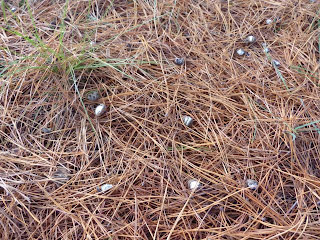
Walking up our drive today I noticed a lot of white objects under a Pinus radiata.  Peering more closely I discovered that they were scats, all of a similar size and nearly all topped with a layer of white. I placed one on a sheet of paper to get a better look at it and the structure appeared to be a thin coil with the white layer deposited on top.   This sample which was about average size (and they were pretty consistent) was 18mm across the whole disc.   This probably makes the individual coils about 3mm thick.  It appeared that they were coming down from the tree above them.  This idea was supported by finding a bunch of the discs about 1.5m above the ground trapped in some needles. I scrutinised the trees in the vicinity quite thoroughly but couldn't see any wildlife that might have done this dirty deed.  Any suggestions as to what it might be will be most welcome. My initial thoughts were along the following lines: Birds tend to splat...

Weather and water

Image
Mark Twain has had many witty sayings attributed to him .  It appears that one of my personal favourites "Whisky is for drinking, water is for fighting over" is of dubious provenance.  Having got to thinking about quaint American (ab)users of language, some more are quoted at the end of this post. An approach to one of the issues which may cause a stoush over water was covered in the TV series " Two Men in a Tinnie " featuring Tim Flannery and John Doyle (the latter aka sports guru "Rampaging" Roy Slaven) travelling down the Murray-Darling system in a small boat.  They made the point at several stops of the trip that people always hate things upstream for 'stealing our water'.  I will return to this, after dealing with recent weather and some history. Weather, with a focus on rain I recently posted about rainfall to late January in our area.  The following table continues for the same 4 stations: Date Carwoola Airport ...

Things loose in the top paddock

Image
A few posts back I mentioned the insects gathered on some Bursaria growing fairly close to our house.  On a walk with the small dog I noticed another spinney of this prickly species. A little later in the day I took myself and the small dog back there to see what was happening  in the way of photographic subjects in the upper part of the block.  As it was somewhat warm (30C) the small dog wimped after a short while so I got some extra exercise doing the trip twice. Here are the images I captured that seem to be worthwhile bothering you with.  I will offer a viewer advisory - especially for folk who are little in the arachnophobic direction - that a couple of the images below show a close up of a spider doing business with a fiddle beetle.  The beetle still alive so there is no need for an advisory about dead things. First is a Flower Scarab ( Polystigma punctata ).  It was unusual to find one of these, on Bursaria, to stay still long enough to be pho...