I have recorded the stages of development in the breeding of the pair of frogmouths that roost in our Yellow Box (Eucalyptus meiodora) in an on-going post. Today I just thought the chicks looked cute (in a malevolent sort of way) rather than needing to be recorded as a 'stage'. So here are a couple of images.
The first one was a tad tricky to take as I was being dive bombed by the Satan-spawn Pied Currawongs that are about to fledge their young in a nest a few metes further up the tree. For the second shot I was pretty much embedded in an Acacia tree so the black bombers couldn't get at me so easily!
Friday, 29 October 2010
Thursday, 28 October 2010
More tales of Platypus and the Queanbeyan River
I have previously posted about watching for platypus from the suspension bridge over the Queanbeyan River. I had a few minutes to spare in town today and took me camera with me.
On arriving at the bridge a lady was walking across pushing a pram with a small child in it. Another lady was at the end of the bridge with
He failed. Despite the big splash other denizens of the riven go on about their business.
Looking West again I find that Bluey has worked out that his owners are heading off home, and has decided that the shortest way home is straight up the stream. A squadron of Australian Wood Ducks decide to make sure he (I don't know why I assumed it was a male: probably because most females wouldn't be so daft) leaves the premises.
So I look back downstream, and there is a platypus. As usual it is is very hard to get the camera organised but I get a snap with a platypus shape and another of the traditional swirl of bubbles! Geez it is nice to know they are there!
The platypus is the dark shape in the water towards the RHS opf the image.
On arriving at the bridge a lady was walking across pushing a pram with a small child in it. Another lady was at the end of the bridge with
- a camera; and
- a blue-heeler cross (aka a mongrel cattle dog).
He failed. Despite the big splash other denizens of the riven go on about their business.
Looking West again I find that Bluey has worked out that his owners are heading off home, and has decided that the shortest way home is straight up the stream. A squadron of Australian Wood Ducks decide to make sure he (I don't know why I assumed it was a male: probably because most females wouldn't be so daft) leaves the premises.
So I look back downstream, and there is a platypus. As usual it is is very hard to get the camera organised but I get a snap with a platypus shape and another of the traditional swirl of bubbles! Geez it is nice to know they are there!
The platypus is the dark shape in the water towards the RHS opf the image.
Wednesday, 27 October 2010
Mt Tennent: images to the Cypress Lookout
Today the ANPS Wednesday Walkers went to the Cypress Lookout, about halfway up Mt Tennent in Namadgi National Park. It was a splendid outing with masses of flowers including a good range of orchids. I will start with a view from the Lookout. Please note this is the ACT, not Ireland!
We have a basic rule when travelling that anywhere with a lot of green vegetation generally gets a lot of rain. That has certainly been the case in the ACT this year and it was also reflected in the water running down a Creek near the Lookout. I mucked about a bit trying to get some arty images: here are a couple of them.
I guess the orchid fanciers will be wondering when I am going to get to the important stuff. I haven't shown here the species of which I have put images from our own block, but here we go, starting with a couple of images of Thelymitra sp.
Next up we have a Spider orchid (Arachnorchis atrovespa I think).
Right near the Lookout a 'rustyhood' was found. I will make a call on this being Oligochilochaetus hamatus.
For those with a strong stomach, here is a photograph (taken by Frances) of me taking the above photograph!
For other plants I will start with a view of a patch of Micromyrtis ciliata with some Pomaderris angustifolia in the background.
Here is a closer shot of the Micromyrtis with some (intentionally and thus artistically) out of focus Stypandra glauca in the background.
Micromyrtis was also popular with a butterfly - possibly the Common Grass Blue ( Zizina labradus). Photo by Frances.
Giving Stypandra a better suck of the sauce bottle (and a plant that pretty deserves a fair slurp) here are:
My final plant image is of a Eucalypt flower. I suspect this is E. dives, but as usual there was some fair discussion of just what species it was. I don't greatly mind: I just think they are fabulous flowers when looked at closely.
The final image is looking up at Mt Tennent from the rocks close to the Lookout.
Despite the foregoing evidence to the contrary, my main role on these walks is to record the birds seen. I recorded 46 species today which is a rather good haul. Another observer (Matthew) was also present, but started a bit earlier than me so had 42 species before I arrived. I would guess his list would have been well over 50 by the end of the walk.
We have a basic rule when travelling that anywhere with a lot of green vegetation generally gets a lot of rain. That has certainly been the case in the ACT this year and it was also reflected in the water running down a Creek near the Lookout. I mucked about a bit trying to get some arty images: here are a couple of them.
I guess the orchid fanciers will be wondering when I am going to get to the important stuff. I haven't shown here the species of which I have put images from our own block, but here we go, starting with a couple of images of Thelymitra sp.
Next up we have a Spider orchid (Arachnorchis atrovespa I think).
Right near the Lookout a 'rustyhood' was found. I will make a call on this being Oligochilochaetus hamatus.
For those with a strong stomach, here is a photograph (taken by Frances) of me taking the above photograph!
For other plants I will start with a view of a patch of Micromyrtis ciliata with some Pomaderris angustifolia in the background.
Here is a closer shot of the Micromyrtis with some (intentionally and thus artistically) out of focus Stypandra glauca in the background.
Micromyrtis was also popular with a butterfly - possibly the Common Grass Blue ( Zizina labradus). Photo by Frances.
Giving Stypandra a better suck of the sauce bottle (and a plant that pretty deserves a fair slurp) here are:
- a close up of that species; and
- another image with that in front of the pandemic Pomaderris.
My final plant image is of a Eucalypt flower. I suspect this is E. dives, but as usual there was some fair discussion of just what species it was. I don't greatly mind: I just think they are fabulous flowers when looked at closely.
The final image is looking up at Mt Tennent from the rocks close to the Lookout.
Despite the foregoing evidence to the contrary, my main role on these walks is to record the birds seen. I recorded 46 species today which is a rather good haul. Another observer (Matthew) was also present, but started a bit earlier than me so had 42 species before I arrived. I would guess his list would have been well over 50 by the end of the walk.
Tuesday, 26 October 2010
Roadside flowers of Stoney Creek
The Stoney Creek Nature Reserve is located beside Captains Flat Road opposite Clydesdale Road in Carwoola. The verge on the Southern side of the road (adjacent to private property) was vandalised by scraping but after a solid set of rains the Northern side of the road has hit its marks running.
Driving past the most obvious plants are a patch of Calotis scabiosifolia var. integrifolia! (Thanks Ros for the update.)
They mixed in with some Bulbine lilies:
Proving that they are not too choosy, the lilies also mixed with Leucochrysum albicans albicans var tricolor which are an officially endangered variety of daisy in this area. The second image shows a native bee displaying interest in a flower and the third is a bud demonstrating the reason for the varietal appendation of 'tricolor!
Driving past the most obvious plants are a patch of Calotis scabiosifolia var. integrifolia! (Thanks Ros for the update.)
They mixed in with some Bulbine lilies:
Proving that they are not too choosy, the lilies also mixed with Leucochrysum albicans albicans var tricolor which are an officially endangered variety of daisy in this area. The second image shows a native bee displaying interest in a flower and the third is a bud demonstrating the reason for the varietal appendation
Flowering for Columbine
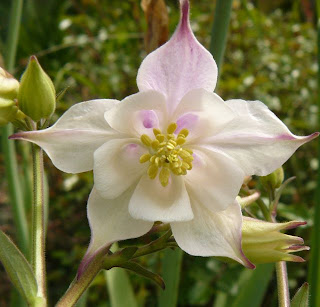
Perhaps the title should have been "Flowering of Columbine"? But that wouldn't have had the Oscar winning resonance. Whatever, here are a few images of the Columbines (in Latin, Acquilegia) growing in our garden. I had thought they were intricate, but basically monochromatic flowers. Obviously I am wrong (as shown by the final image, some varieties are polychromatic).
Also beginning to hit its straps is a Wisteria. This is, as far as I am aware, totally unrelated to Acquilegia but it is flowering now, and is pretty, so here is an image!
Monday, 25 October 2010
CANCELLED the COG trip to Yanununbeyan SCA
THE OUTING PLANNED TO YANUNUNBEYAN FOR SATURDAY 4 DECEMBER HAS BEEN CANCELLED DUE TO PROBABLE POOR WEATHER AND DANGEROUS ROAD CONDITIONS.
This is to hold my plans for the COG outing on December 4 2010.
I suggest people meet to carpool at the Spotlight car park in Queanbeyan (see below for maplet) at 8am. It would be good to minimise the number of cars because:
Road conditions and other 'duty of care' information
There is about 40km of dirt road on the agenda. I have been everywhere we are planning to go in a 2WD car. However there has been a lot of rain and we have a few creeks and gutters to cross. Subaru Foresters and above would have no difficulty.
The road to Woolcara Gate is very good quality dirt road. The next 7km (approx) is a public right of way through private property. There are several cattle grids with poor visibility 'over the top': be alert. The paddocks on either side of the track are unfenced and have stock grazing and at times wandering across the road.
Once in the SCA or NP the road narrows and is less well maintained.
We will be walking off the track in a variety of situations. Use common sense appropriate to the Australian bush in Summer.
Carry water and use sunscreen and bug repellent.
We will have lunch close to the cars so no need to shlep your meal.
To business
I have no specific stops in mind while traversing Woolcara or Silverton. If we see something good and it is safe to stop, we will of course do so. By way of example:
The starting point is the list of birds I have compiled from my various visits to the area, plus a list provided from the Atlas of NSW Wildlife.
I would add to this, as a possibility, Painted Button-quail> on one of my recent visits to the area a lot of 'platelets close to stop 6. I also note that we are not far from a property at Urila (on the far side of the Queanbeyan River) owned by a member of COG who has recorded a very good number of unusual birds in recent years. So eyes and ears open!
This is to hold my plans for the COG outing on December 4 2010.
I suggest people meet to carpool at the Spotlight car park in Queanbeyan (see below for maplet) at 8am. It would be good to minimise the number of cars because:
- Carbon footprint issues;
- Woolcara Trail is narrow and dirt so the less traffic the better;
- Parking is not always able to accommodate a large number of cars.
Directions
- On leaving the Spotlight carpark head off towards Bungendore on the Kings Hwy and take the turn off to Captains Flat (approximately 4km on the right with a snazzy new roundabout).
- After approx 14km, regroup at the junction of Briars Sharrow Rd and Captains Flat Rd.
- After a further 4km (after passing Carwoola homestead) turn right into Woolcara lane. This is good quality dirt.
- After about 5 km the road enters Woolcara Station and after a further 7km enters the State Conservation area.
Road conditions and other 'duty of care' information
There is about 40km of dirt road on the agenda. I have been everywhere we are planning to go in a 2WD car. However there has been a lot of rain and we have a few creeks and gutters to cross. Subaru Foresters and above would have no difficulty.
The road to Woolcara Gate is very good quality dirt road. The next 7km (approx) is a public right of way through private property. There are several cattle grids with poor visibility 'over the top': be alert. The paddocks on either side of the track are unfenced and have stock grazing and at times wandering across the road.
Once in the SCA or NP the road narrows and is less well maintained.
We will be walking off the track in a variety of situations. Use common sense appropriate to the Australian bush in Summer.
Carry water and use sunscreen and bug repellent.
We will have lunch close to the cars so no need to shlep your meal.
To business
I have no specific stops in mind while traversing Woolcara or Silverton. If we see something good and it is safe to stop, we will of course do so. By way of example:
Within Yanununbeyan.
I am planning 6 - 7 stops. I'd expect us to be heading home no later than 3pm: if folk wish to leave sooner that will be simply arranged: but please tell me first!!
- Corner Hill: it is a bit uphill but on a degraded track so relatively easy walking. Probably about 2km return, (grassland and box-grassy stuff) We may bush bash back to the cars if people so wish.
- Murdering Sheep Flat 35:33.057 S 149:21.056E (see above)
- Perhaps a roadside stop before The Spring homestead if there seems to be action. Otherwise stop at the nnd of road (13.7 from Woolcara) 35:35.219E 149:21.335S Snuffle in area, check farmland and dams.
- Lunch stop at creek. 35:34.769S 149:21.589E
- Spring Creek trail end (3.5km from start). This is National Park not SCA
- Creek on way back 35:33.911S 149:22.862E (0.9 from end of track)
Birds to be seen
The starting point is the list of birds I have compiled from my various visits to the area, plus a list provided from the Atlas of NSW Wildlife.
| Yanununbeyan composite | ||
| C&B 2 Taxonomic Code |
RAOU
|
name
|
| 39 |
211
| Grey Teal |
| 44 |
208
| Pacific Black Duck |
| 63 |
34
| Common Bronzewing |
| 75 |
44
| Wonga Pigeon |
| 88 |
313
| Tawny Frogmouth |
| 96 |
317
| Australian Owlet-nightjar |
| 101 |
334
| White-throated Needletail |
| 222 |
188
| White-faced Heron |
| 226 |
192
| Nankeen Night Heron |
| 244 |
221
| Brown Goshawk |
| 245 |
222
| Collared Sparrowhawk |
| 252 |
224
| Wedge-tailed Eagle |
| 255 |
239
| Brown Falcon |
| 281 |
56
| Dusky Moorhen |
| 306 |
144
| Black-fronted Dotterel |
| 410 |
267
| Yellow-tailed Black-Cockatoo |
| 413 |
268
| Gang-gang Cockatoo |
| 419 |
269
| Sulphur-crested Cockatoo |
| 436 |
282
| Crimson Rosella |
| 437 |
288
| Eastern Rosella |
| 468 |
342
| Horsfield's Bronze-Cuckoo |
| 472 |
337
| Pallid Cuckoo |
| 478 |
248
| Powerful Owl |
| 480 |
246
| Barking Owl |
| 481 |
242
| Southern Boobook |
| 493 |
322
| Laughing Kookaburra |
| 498 |
326
| Sacred Kingfisher |
| 508 |
350
| Superb Lyrebird |
| 511 |
558
| White-throated Treecreeper |
| 513 |
560
| Red-browed Treecreeper |
| 514 |
555
| Brown Treecreeper |
| 527 |
529
| Superb Fairy-wren |
| 556 |
488
| White-browed Scrubwren |
| 580 |
470
| Striated Thornbill |
| 582 |
486
| Yellow-rumped Thornbill |
| 584 |
484
| Buff-rumped Thornbill |
| 589 |
475
| Brown Thornbill |
| 594 |
565
| Spotted Pardalote |
| 597 |
976
| Striated Pardalote |
| 598 |
591
| Eastern Spinebill |
| 608 |
614
| Yellow-faced Honeyeater |
| 614 |
617
| White-eared Honeyeater |
| 616 |
619
| Yellow-tufted Honeyeater |
| 633 |
638
| Red Wattlebird |
| 659 |
583
| Brown-headed Honeyeater |
| 661 |
578
| White-naped Honeyeater |
| 666 |
645
| Noisy Friarbird |
| 678 |
436
| Spotted Quail-thrush |
| 686 |
549
| Varied Sittella |
| 695 |
416
| Crested shrike-tit |
| 699 |
398
| Golden Whistler |
| 707 |
408
| Grey Shrike-thrush |
| 719 |
702
| Grey Butcherbird |
| 722 |
705
| Australian Magpie |
| 723 |
694
| Pied Currawong |
| 725 |
697
| Grey Currawong |
| 730 |
361
| Grey Fantail |
| 733 |
364
| Willie wagtail |
| 737 |
930
| Australian Raven |
| 744 |
365
| Leaden Flycatcher |
| 757 |
693
| White-winged Chough |
| 767 |
380
| Scarlet Robin |
| 769 |
382
| Flame Robin |
| 776 |
392
| Eastern Yellow Robin |
| 806 |
357
| Welcome Swallow |
| 818 |
991
| Common Blackbird |
| 829 |
564
| Mistletoebird |
| 839 |
662
| Red-browed Finch |
| 254 |
240
| Nankeen Kestrel |
| 763 |
377
| Jacky Winter |
I would add to this, as a possibility, Painted Button-quail> on one of my recent visits to the area a lot of 'platelets close to stop 6. I also note that we are not far from a property at Urila (on the far side of the Queanbeyan River) owned by a member of COG who has recorded a very good number of unusual birds in recent years. So eyes and ears open!
Sunday, 24 October 2010
Too many orchids ...
.. are never enough.
After a very frustrating day yesterday when I couldn't find any of the 'specials' we'd located on Tuesday we set off again this morning and ticked off most everything. We even got an addition: Hymenochilus bicolor, which Frances found close to Glossodia Central. The distinguishing feature is the shape of the 'black bit' (known I believe as a labellum appendage) which is m-shaped rather than the T of H. cycnocephalus.
Here is a picture.
The next cab off the rank is a Diuris. I have concluded that this is D. pardina, the Leopard orchid on the basis of several of the plants having 3 leaves and the colour of the stems. As always I am open to correction!
The first image is from this morning, looking from above the flower and has a nice effect of dew - for once I had my camera with me at the required time.
Next we have a front on shot in mid afternoon, followed by a group photo of several open flowers.
A couple of days later we went for another prowl and found our first Diuris sulphurea for the season. A couple of images follow. Note: the lack of brown on the sepals; the green stems and the bright yellow petals and sepals.
On this extra day we also found a stack of Stegostyla ustulata. While they have their own post, I really like this image so have popped it in here.
The final bit is one for the specialists. It is I think a group of leaves which may eventually be accompanied by Microtis flowers. These are not the most elaborate flowers going, but those who believe small is beautiful will enjoy them (if the kangaroos and hares don't eat them all).
Assuming that I have the correct diagnosis of this greenery it is progressing well. (Actually I am not sure about that, since once it flowers we will than have to decide what species it is. There seem to be 2 possible Microtis sp in this area and they are distinguished by by detail of the labellum, which is about 1.5mm in length!)
The collection in the image above are taking their time about flowering. However while looking for a sun orchid about 50m away I found this nice Microtis bud (and three buds of sun orchids - c'mon sun!).
And now for something completely different, buds of Thelymitra sp. The first I am not sure about as it is growing with the slower developing Microtis. I am being bolder about the second, and calling it T pauciflora, because that has flowered in exactly the same position in the past!
As we have some warmer days scheduled, I am hopeful we might see some action in the next few days!
After a very frustrating day yesterday when I couldn't find any of the 'specials' we'd located on Tuesday we set off again this morning and ticked off most everything. We even got an addition: Hymenochilus bicolor, which Frances found close to Glossodia Central. The distinguishing feature is the shape of the 'black bit' (known I believe as a labellum appendage) which is m-shaped rather than the T of H. cycnocephalus.
Here is a picture.
The next cab off the rank is a Diuris. I have concluded that this is D. pardina, the Leopard orchid on the basis of several of the plants having 3 leaves and the colour of the stems. As always I am open to correction!
The first image is from this morning, looking from above the flower and has a nice effect of dew - for once I had my camera with me at the required time.
Next we have a front on shot in mid afternoon, followed by a group photo of several open flowers.
A couple of days later we went for another prowl and found our first Diuris sulphurea for the season. A couple of images follow. Note: the lack of brown on the sepals; the green stems and the bright yellow petals and sepals.
On this extra day we also found a stack of Stegostyla ustulata. While they have their own post, I really like this image so have popped it in here.
The final bit is one for the specialists. It is I think a group of leaves which may eventually be accompanied by Microtis flowers. These are not the most elaborate flowers going, but those who believe small is beautiful will enjoy them (if the kangaroos and hares don't eat them all).
Assuming that I have the correct diagnosis of this greenery it is progressing well. (Actually I am not sure about that, since once it flowers we will than have to decide what species it is. There seem to be 2 possible Microtis sp in this area and they are distinguished by by detail of the labellum, which is about 1.5mm in length!)
The collection in the image above are taking their time about flowering. However while looking for a sun orchid about 50m away I found this nice Microtis bud (and three buds of sun orchids - c'mon sun!).
And now for something completely different, buds of Thelymitra sp. The first I am not sure about as it is growing with the slower developing Microtis. I am being bolder about the second, and calling it T pauciflora, because that has flowered in exactly the same position in the past!
As we have some warmer days scheduled, I am hopeful we might see some action in the next few days!
Subscribe to:
Posts (Atom)